Advanced systems designed for commercial architectural glass, structural silicone sealant applications, and high-performance glass profiles.
Years Engineering Excellence
R&D Machinery Patents
Global Export Destination Countries
Drilling Precision Tolerance (mm)
Modern architectural trends increasingly rely on expansive, high-performance building envelopes. The global demand for curtain wall systems is driven by stringent carbon neutrality policies, building energy codes (such as the EU's EPBD and North America's ASHRAE 90.1), and an architectural preference for natural lighting. Advanced curtain wall glass production lines are no longer simple conveyor systems; they are highly integrated, cyber-physical ecosystems that process heavy double-glazed and triple-glazed units (IGUs) with extreme structural integrity.
From dynamic structural glazing to spectrally selective low-emissivity (Low-E) coatings, producing curtain wall units requires specialized equipment. This machinery must handle massive glass loads, execute precision CNC edge deletion of metallic coatings, perform triple-barrier sealing, and inject noble gases like argon or krypton with absolute gas retention over decades. System builders must evaluate supplier factories not only on hardware components but on their integrated control systems, software intelligence, and ability to handle specialized raw materials.
"The modern building envelope is the primary barrier controlling solar gain, acoustic transmission, and thermal exchange. Achieving a U-value of less than 0.8 W/m²K on structural glass facades requires a production line that guarantees airtight assembly, uniform primary PIB sealing, and 90%+ argon gas filling density."
Shandong province has established itself as the global epicenter for glass deep-processing machinery. Supported by a robust industrial supply chain, manufacturers like Shandong Yabo CNC Machinery Co., Ltd leverage immediate access to local raw casting, high-precision linear guides, top-tier pneumatic systems, and localized CNC software development. This regional integration enables production costs to stay competitive while meeting stringent international standards (such as EN1279 and SGCC).
Furthermore, the resilience of the Chinese supply chain ensures that components, customized tooling, and structural steel frames are sourced, machined, heat-treated, and assembled under centralized quality assurance frameworks. For global developers and commercial glass processors, this results in shorter production lead times, customizable structural footprints, and rapid execution of high-mix, low-volume manufacturing orders.
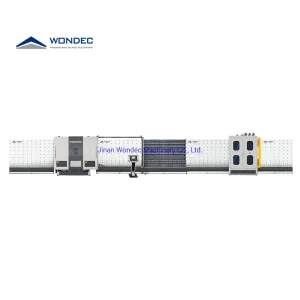
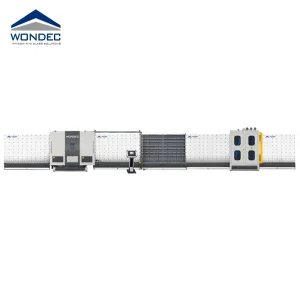
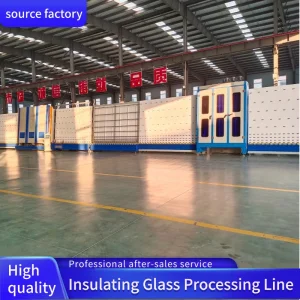
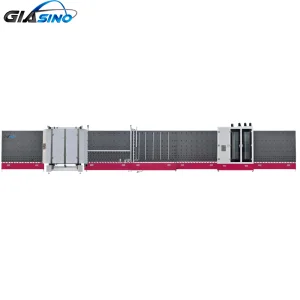
Inside the automated stages of a high-performance commercial curtain wall insulating glass assembly line.
Automatic loading, high-speed washing using demineralized water (critical for low-E glass life), and precise CNC edge deletion of low-E soft coatings to ensure optimal bonding of structural silicone.
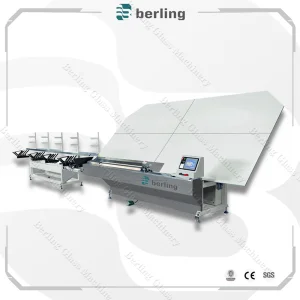
Automated spacer bending machines construct frames with high-performance warm-edge or aluminum profiles. Extruders apply primary PIB sealant to the sides of the spacer with absolute volumetric control.
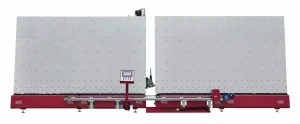
Automated vertical flat press chambers assemble glass sheets, inject argon gas up to 90% concentration, and output panels directly to secondary sealing robots for structural silicone or polysulfide coatings.
The integration of Industry 4.0 paradigms represents the next leap for curtain wall glass production. Modern factories are deploying AI-based optical inspection systems immediately after the washing cycle and the gas-press cycle. Using high-resolution linear sensors and artificial neural networks, these diagnostic arrays check for microscopic scratches, pinholes, structural defects in the Low-E film, and gas volume ratios.
By embedding IoT modules into CNC glass-cutting, spacer-bending, and automatic sealing robots, manufacturers can remotely monitor mechanical wear, trace material consumption, and run preventive diagnostics. This ensures maximum machine uptime, critical for processing large-scale architectural projects under tight building commission deadlines.
Shandong Yabo CNC Machinery Co., Ltd (often recognized globally under its CNC brand heritage) is a professional manufacturer of Insulating Glass Machine and lines for already 18 years. Based on strong technical support and dedicated after-sale services, the company has developed rapidly to become an industry benchmark.
We focus on high-quality machine production and supply, including design, R&D, manufacture, and comprehensive after-sale service. Our key machinery lineup features the Automatic Insulating Glass Machine, Insulating Glass Line with Argon Gas Filling Function, Automatic Glass Sealing Machine, High-Speed Glass Washing Machine, and Glass Cutting Machine, providing the full spectrum of glass deep-processing machinery.
With a continuous focus on innovation and product design, we have secured 22 patents for our products and remain committed to constant technical advancement to meet evolving global standards.
Leveraging a technical team with more than 20 years of experience, unique hardware and software patents, and a professional, responsive after-sales service network, we guarantee long-term operational efficiency for custom architectural projects.

Service Time: 7*24 Hours, 365 Days; Special Design for Your Special Requirement; We Use the Latest Equipment and Technology.

Standard Precision Produce; Orders tracking Report or Videos; Orders finished Report or Testing Videos.

On-line Service: 7*24 Hours, 365 Days; Can Come for Installation if necessary; Can Come for Maintenance if necessary; Spare Parts Supply for the Whole Machine Life.

Supply Reliable Local Service System; Machine Lifetime Service and Maintenance; Looking for Global Agent Partners.
Curtain wall glass requirements vary significantly depending on localized microclimates, regional structural codes, and seismic activities:
Exporting structural glazing equipment requires strict compliance with international mechanical and electrical protocols. Equipment deployed to Europe must comply with the Machinery Directive 2006/42/EC and display the CE mark. Lines destined for North American facilities require UL or CSA certifications for electrical panels, control units, and servo motor systems.
Furthermore, the production lines output must conform to strict glazing norms (such as standard EN 1279 for IGU quality validation and gas concentration retention, and ASTM E2190 for performance standards). Choosing a manufacturer with in-house certified engineering, automated testing protocols, and global field technicians ensures seamless commissioning and local inspection approvals.
Essential technical and sourcing insights for buyers selecting curtain wall glass production lines.
Complete assembly lines, automated argon gas filling devices, spacer benders, and high-performance sealing systems.
 Yabo CNC